The institutional absurdity of scientific research
Journey to the End of the NightThe institutional absurdity of scientific research in the novel lies in the distance between science’s public authority and the precarious, repetitive, and self-protective labor behind it. When Ferdinand Bardamu visits the Joseph Bioduret Institute seeking guidance about Bébert’s typhoid, he encounters an institution where material neglect, careerist ritual, and professional reputation overwhelm the ideal of disinterested inquiry. The scene’s satire is not simply that researchers fail; it shows how routine and status can make failure durable, and how people keep performing confidence in a system whose practical and intellectual value is uncertain.
The Institute and Its Daily Conditions
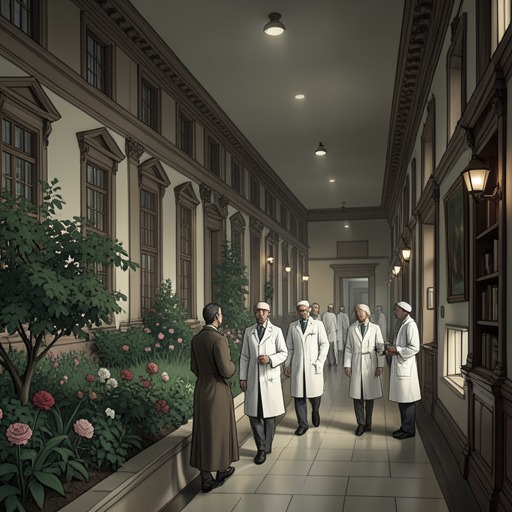
Bardamu’s visit begins in search of useful medical advice, but the Institute first appears as a place where research has become detached from any visible urgency. Its laboratories are sparsely occupied when he arrives, and the surroundings include damaged equipment and disordered materials. The institution’s memorial to Joseph Bioduret, with its gold and marble, provides a grand contrast to the ordinary working environment. Even the collection taken on the way out, and the guard’s complaint about a Belgian coin, bring the lofty setting down to small, tangible transactions.
The staff’s circumstances make the contrast sharper. Assistants arrive carrying provisions from a nearby market, while the researchers appear later, moving slowly through the corridors. They are depicted as underpaid and worn down by routine, spending their working lives among experiments and materials that the narrative presents as neglected. The Institute’s official prestige does not translate into material security for the people who sustain it. Their attachment to the institution is bound to their need to retain a position and the title of official scientist, which helps pharmacists continue to trust them with analyses of urine and sputum, even for meager pay.
The laboratory’s everyday procedures turn that precariousness into a way of life. A researcher spends time looking at the remains of an earlier experiment; replacement is delayed by Professor Jaunisset’s thrift. Laboratory workers adapt to the conditions, and some use the burners to prepare food. Cigarettes help carry them through the smell and boredom, while the day’s materials are put away and warmed again in an old incubator cabinet. Octave, the technician, hides cooked beans behind a newspaper to take home. Research, subsistence, and evasion share the same cramped space: the institution’s work continues, but much of its practical activity is directed toward enduring the day.
Routine, Thrift, and the Production of Papers
The Institute’s routines are sustained not by a clear account of scientific progress but by habit, limited resources, and the need to justify employment. Its researchers work among animal materials and improvised conditions, then produce papers whose purpose is partly institutional: publication helps demonstrate that their presence at the Institute and its meager advantages are warranted. The ritual of writing therefore has a double function. It presents research as a continuing intellectual enterprise, while also serving as proof that a researcher still belongs in the organization.
The narrator describes this as a system in which familiarity arrives more quickly than courage. Once someone has learned to subsist in a professional niche, leaving it risks a kind of institutional and material death. That observation links the researchers’ adherence to routine with the insecure conditions surrounding them. Their work may be unrewarding, but the position it provides is still something to protect. The Institute’s absurdity is consequently more than individual laziness or incompetence: it is an order in which small advantages, titles, and repeated procedures keep the organization running without guaranteeing meaningful discovery.
The same tension between scientific authority and its actual practice appears in the Institute’s hierarchy. Professor Jaunisset’s thrift shapes what the laboratory will replace and when; the researchers and technicians work within those limits, and their private accommodations become part of the operating routine. Yet the formal image of science remains intact. The institution can continue to confer titles and sustain professional trust even while its daily conditions expose how little material support stands behind that authority.
Parapine: Reputation and Competition
Serge Parapine provides the clearest case of professional success built out of a mixture of genuine expertise, public reputation, and accumulated habit. He is described as an established authority on typhoid in animals and humans. His standing dates from a celebrated episode in which he answered German researchers’ claim about isolating Eberthella by cultivating the microbe in the sperm of a seventy-two-year-old invalid. The episode made him famous, and he maintained that attention through medical-journal publications that the narrator describes as difficult to read.
Parapine’s professional authority is also protected by the very people who might be expected to assess his work. The serious scientific public trusts him implicitly and therefore does not need to read him. The observation turns reputation into a self-sealing arrangement: trust confirms status, while the absence of close reading leaves the work largely untested. The narrative does not deny that Parapine has specialized knowledge; it shows how that knowledge sits alongside a professional culture in which celebrity and collective deference can substitute for scrutiny.
His account of typhoid research reveals the pressure of competition beneath that authority. Parapine says that the field has become crowded with specialists and publications, and that he now repeats and revises the same article from congress to congress and journal to journal, making small changes to preserve his position. The subject that once gave him a route to distinction has become a crowded professional market. His response is not renewed ambition but a search for a quiet corner of research, free of enemies and disciples, that might provide a modest, unjealous celebrity.
His proposed study of central heating’s comparative influence on hemorrhoids makes that retreat comic, but also precise. Parapine imagines a subject likely to appeal to older Academy members and asks whether it might earn him a hygiene award worth ten thousand francs. The project is attractive to him not chiefly as a path to knowledge, but as a manageable route to recognition and a possible trip to Venice. His ambitions are modest in scale but revealing in kind: scientific work has become a way of securing a livable niche, and the choice of a research topic is weighed against professional safety and material reward.
Belief, Skepticism, and the Institution’s Ironies
Parapine’s private contempt for scientific life sits beside the devotion of the technician who works under him. He describes the technician as having spent nearly thirty years clearing away his discarded materials, yet still believing in science and admiring the cultures he handles. The technician’s faith is especially striking because Parapine regards his own experiments as meaningless or buffoonish. Scientific belief is thus distributed unevenly: the senior researcher speaks with corrosive skepticism, while the subordinate invests the work with significance.
Parapine compares this division to religion: the practitioner has ceased to believe, while the attendant remains devoted. He extends the comparison to Bioduret, whom he portrays not as an uncomplicated scientific hero but as a man whose reputation eclipses his petty habits and quarrelsome character. Parapine’s criticism is not a neutral assessment—the Institute’s own narrator presents him as resentful and outspoken—but it punctures the assumption that fame reliably corresponds to admirable character or intellectual greatness. His attack on Bioduret also implicates the institution that preserves the founder’s prestige while its ordinary workers endure underpaid, repetitive conditions.
The scene’s central irony is that skepticism does not free Parapine from the system he mocks. He can denounce research, ridicule scientific celebrity, and recognize the technician’s misplaced faith, yet he still needs an academic position and hopes for an award. The Institute’s absurdity is therefore maintained by more than belief: even disbelief can serve as a survival strategy within it. The researcher knows enough to see the hollowness of some professional rituals, but not enough—or not securely enough—to stop participating in them.
Bardamu’s Visit and the Limits of Expertise
Bardamu comes to the Institute because Bébert’s illness has made him anxious to do everything possible. He has traveled from Rancy hoping that Parapine will offer advice about the case. Instead, the search leads through an institution whose routines and professional complaints absorb much of the encounter before the patient’s problem is addressed. When Parapine remembers why Bardamu came, he admits that the competing theories and uncertain experiments give him no sound basis for choosing a course. His practical recommendation is to do his best.
That response exposes a limit that institutional authority cannot conceal. Parapine possesses extensive knowledge and a reputation in the field, but neither supplies a decisive answer for Bébert. His candor is valuable precisely because it refuses to turn professional standing into a promise of certainty. At the same time, his confession that typhoid research disgusts him and has become a field of repetitive publications makes his advice inseparable from his own exhaustion and disillusionment.
Through Bardamu’s visit, scientific research becomes one of the novel’s examples of an institution whose formal prestige and practical limitations coexist. The gold-and-marble memorial, official titles, published papers, and recognized expertise promise a coherent world of knowledge; low wages, improvised routines, unexamined reputations, and inconclusive advice reveal the instability underneath. The satire does not require science to be wholly fraudulent. It is sharper because knowledge, labor, self-interest, and genuine uncertainty remain entangled, leaving both the researcher and the patient to manage what the institution cannot resolve.